









いま読まれてます
The Ill-Fated Second Album ‘BOY’ That Was Shelved
Around 1981, talk arose again of a “solo album” production for Yoichi Takizawa, who had begun working as a dedicated composer providing kayōkyoku songs to idols, talents, and singers. This was the phantom second album ‘BOY’ that appeared at the beginning of Vol. 1 of this series.

Yoichi Takizawa ‘BOY’ idea of LP Design. image by: Takizawa’s family
Production of ‘BOY’ began when Jun Takagi (deceased), director at Alfa-affiliated music publishing company “K Music Publishing” where Takizawa was contracted, introduced Takizawa to Yutaka Iori, director at “Warner Pioneer (now Warner Music Japan).” Iori is known for later working on “Muji Ryōhin’s” in-store BGM.
In autumn 1981, a recording camp lasting about 10 days was held at Kitty’s “Izu Studio” (Ito City, Shizuoka Prefecture), Japan’s first resort studio, with Takizawa, participating musicians, both directors Iori and Takagi, and engineer Nobuo Ishizaki staying on-site.
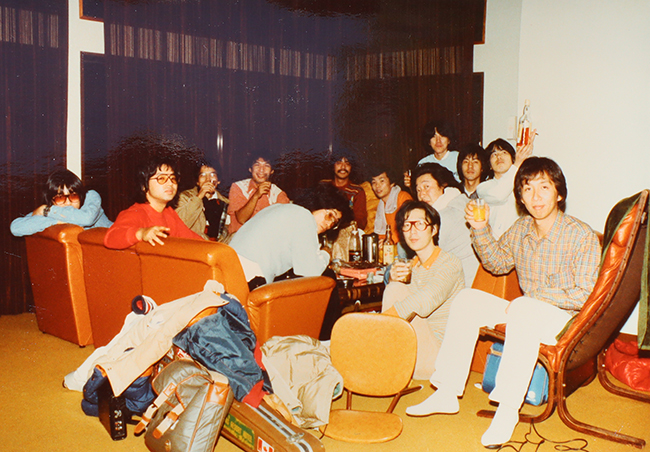
‘BOY’ recording team in Izu Studio 1981
The album was scheduled for release on July 25, 1982, but was postponed and ‘BOY’ was “shelved.” The author learned of the album’s existence from a small “Album Release Notice” in the lyric card of Takizawa’s last single ‘Sunday Park’ (released June 25, 1982, Warner). ‘BOY’ was supposed to appear in stores one month after this last single was released.
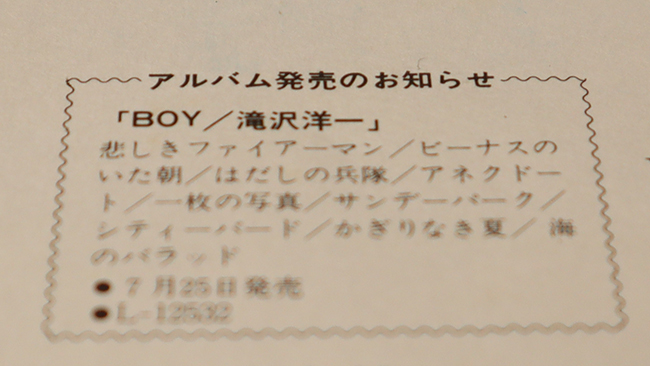
‘Album Release Notice’ in the lyric card of Takizawa’s last single ‘Sunday Park’ 1982
According to bereaved family members, the album failed internal sales meeting selection just before release, and combined with circumstances including Iori’s transfer to Ryohin Keikaku, ‘BOY’ became a phantom album.
‘BOY’ was planned to include two Takizawa self-cover songs.
One was “City Bird,” Takizawa’s version of the masterpiece he provided to Beat Takeshi. This song saw the light of day as the B-side of Takizawa’s last single ‘Sunday Park,’ and was also included as a bonus track when ‘Leonids’ was first released on CD in 2015, becoming available on streaming services in June 2021.
The other self-cover was “Kagirinaki Natsu” (Endless Summer), which he provided to Hideki Saijo. This song made it to the world by being included on Saijo’s album ‘GENTLE A MAN’ (1984). The album was first released on CD on October 30, 2013, and reissued on December 23, 2022, after about nine years.

西城秀樹『GENTLE・A MAN』(1984年)
Strictly speaking, “Kagirinaki Natsu” wasn’t a self-cover but the “phantom original version” that was provided to Hideki Saijo because Takizawa’s ‘BOY’ was shelved.
The title “Kagirinaki Natsu” came from Takizawa, a fan of novelist Yoshio Kataoka (known for ‘Slow Boogie’), requesting lyricist Sonomi Ari to write lyrics inspired by Kataoka’s novel ‘Endless Summer 1’ (1981, Kadokawa Bunko).

‘Endless Summer’ Yoshio Kataoka 1981 Kadokawa Bunko
The City Pop Pioneer Who Spread It Worldwide Speaks on the Universality of “Kagirinaki Natsu”
One man was fascinated by Hideki Saijo’s “Kagirinaki Natsu.”
Van Paugam.
Active as a DJ in Chicago, Illinois, USA, he was the person who mixed Japanese city pop and introduced it to music fans worldwide via YouTube.

Van Paugam
Active as a DJ in Chicago, Illinois, USA, he was the person who mixed Japanese city pop and introduced it to music fans worldwide via YouTube.
Van was among the first to publish city pop mixes on his personal YouTube channel in 2016. By January 2019, his channel had over 90,000 subscribers, with total views exceeding 2 million across all videos.
Western music fans were captivated by Japanese city pop they heard for the first time through his mixes, amazed that such cool music had been created in such quantities in an island nation in the Far East during the 70s and 80s.
But tragedy struck Van.
In 2019, Van’s channel received a “copyright infringement” warning from a Japanese recording industry organization. He repeatedly negotiated with the organization to legally re-upload his mixes with proper licensing credits, but his wishes weren’t granted. On February 14, 2019, his YouTube channel was permanently deleted.
Later, YouTube policy changes allowed music-related videos if license holder company names were credited within the video, and many other DJs’ city pop mix videos are now published without problems.
Van Paugam lost his account because he spread city pop too early. When the global city pop boom arrived, few remembered his name.

Internet archive of Van’s YouTube channel (2019 deleted)
This parallels the existence of Yoichi Takizawa, called a city pop pioneer but whose talent wasn’t recognized during his lifetime.
The mix Van uploaded to YouTube in 2017 still remains on Mixcloud.
Listening now, DJ Van Paugam’s foresight is amazing – it featured only city pop masterpieces now experiencing worldwide reevaluation: Mariya Takeuchi’s “Plastic Love,” Miki Matsubara’s “Mayonaka no Door,” “LOVE TALKIN’ (Honey It’s You)” from Tatsuro Yamashita’s ‘FOR YOU,’ Haruomi Hosono’s “SPORTS MAN,” plus Toshiki Kadomatsu, Junko Yagami, Chiemi Manabe, Hitomi Toyama, Takako Mamiya, Junko Ohashi, Mai Yamane, and Kanako Wada.
Furthermore, in April 2017, he mixed and introduced Tomoko Aran’s “Midnight Pretenders” (sampled by Canadian singer-songwriter The Weeknd on his 2022 album ‘Dawn FM’) and Hiroshi Sato’s “Say Goodbye” (highly rated in the West), among other city pop songs now more popular overseas than in Japan.
He was truly the catalyst and genuine pioneer of today’s global Japanese city pop boom.
Such Van Paugam was discovered to love Takizawa’s composition and Shinkawa’s arrangement of Hideki Saijo’s “Kagirinaki Natsu” as a city pop masterpiece, even creating a special page to introduce it.
The page features English translations of “Kagirinaki Natsu” collaboratively translated by Hideki Saijo fans @Silasmybairn and @Goldenearrigs on X, and embeds a YouTube video of Saijo singing the song.
Through this page, I learned that Van was the DJ who pioneered mixing and spreading Japanese city pop worldwide.
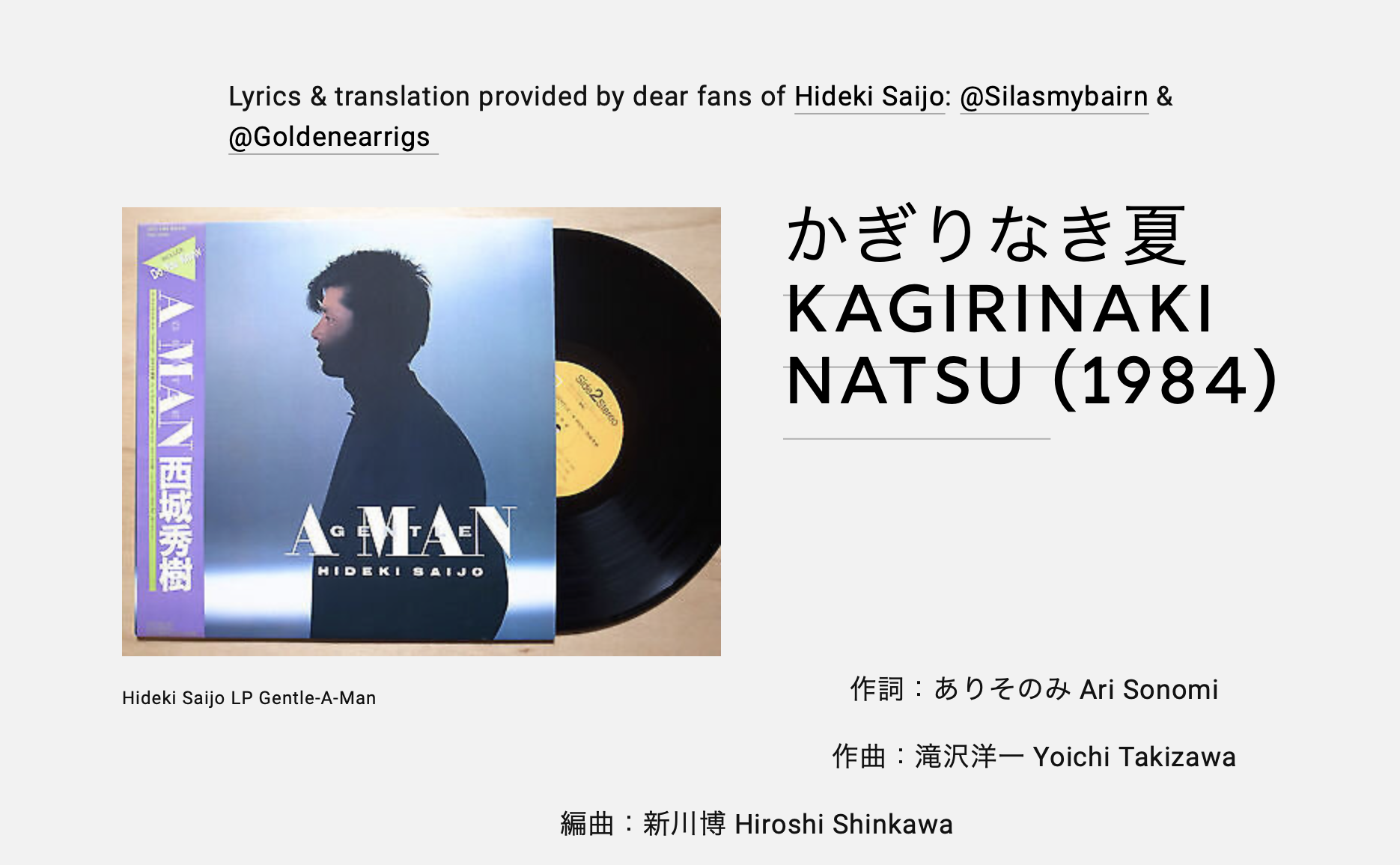
Van Paugam web site [Kagirinaki Natsu] Special page
Knowing he was such a devoted fan of Japanese city pop, especially Hideki Saijo and “Kagirinaki Natsu,” I contacted him via email.
Interview Excerpts:
———I learned you’re a big fan of Hideki Saijo’s “Kagirinaki Natsu.” How did you discover this song?
Van: “I first heard it several years ago while researching Hideki’s music. Since then, it’s become one of my favorite songs by him, and I often credit it as one of his representative works.”
———I want to spread awareness of your name as a city pop boom pioneer to more Japanese people. Please tell me about discovering city pop and how much you love this music.
Van: “As a second-generation immigrant to America born in Miami, Florida, I never felt connected to American culture. I harbored admiration for Japanese culture and spent years nurturing that love.
When I encountered city pop, I felt like I’d found my purpose in life. By spreading music many had forgotten, I could bring happiness to many people, including myself. I found a way to reconnect with something sleeping inside me.
City pop became a good tool for awakening new understanding about myself, the West, and Japan. The fact that many Japanese had forgotten this music was incredible to me – compiling these songs in mixes for the first time felt like a ‘new frontier.’ I think I was acting as my spirit commanded.
Several years after I uploaded city pop mixes, American record companies used many songs from my mixes on city pop compilations, but my work creating the catalyst for these music’s rediscovery in the West was never credited.
When my channel was deleted, I felt betrayed. I thought ‘If I had been Japanese, maybe I would have been more accepted.’ Even now, talking about this topic feels very painful, so I try not to think about it.
Now, even without my own YouTube channel, I play music at live events for people’s enjoyment. Music still brings happiness while carrying melancholy – I’ll always love music as something that gives such magic.
City pop has the power to connect people worldwide, and now unleashed into new generations’ hearts, it will never be forgotten again.“
Van sent me a video where he evaluated Hideki Saijo’s “Kagirinaki Natsu”:
“The song ‘Kagirinaki Natsu’ composed by Yoichi Takizawa can only be described as music constructed with beauty that appeals to sensibility.
There are various modes within one song, building listener expectations while intense ‘choruses’ surge forward.
Hideki Saijo’s voice perfectly fits this song, with lyrical expression synchronized with melody achieving beautiful effect.
The song’s theme is also very beautiful yet tinged with melancholy.
Simply put, I think it’s a ‘perfect song.'”
“Endless Summer” by Hideki Saijo – called a “perfect song” by DJ Van, the “true pioneer” who spread Japanese city pop worldwide faster than anyone.
But the “miracle” of this song didn’t end there.
One Sheet of Music Discovered at the Lyricist’s Home After 42 Years
Through the “Uramado Blog,” I was able to connect with lyricist Sonomi Ari, who wrote the lyrics for this song.
Ari had worked mainly in 70s-80s idol kayōkyoku and New Music genres, writing Crystal King’s hit “Daitokai” B-side gem “Jiryū,” Junko Yagami’s “I’m A Woman,” and Yū Hayami’s “Taiyō no Koibito.” She also wrote lyrics for Takizawa’s ‘BOY’ single-cut ‘Sunday Park,’ and even after more than 40 years, she considers “Kagirinaki Natsu” her representative work.
According to Ari, she was commissioned to write “Kagirinaki Natsu” lyrics by Yutaka Iori, director of Takizawa’s phantom second album ‘BOY.’
Ari: “Since Takizawa worked melody-first, those lyrics were truly brought by Takizawa’s melody. That beautiful song made me write those lyrics.”
Like many other Takizawa works, this was “melody-first.” The fantastical, beautiful male-female descriptions and summery lyrical world were brought by that melody.
Moreover, Ari deliberately didn’t read Kataoka’s ‘Endless Summer 1’ despite the “Kataoka Yoshio novel imagery” order.
Ari: “I’d always loved Kataoka Yoshio’s works including their impressive titles, but I deliberately didn’t read ‘Endless Summer 1’ for the lyricist work. I think it was good I didn’t read it – I avoided being unduly influenced.”
The image of “you” seen only in profile and “I” reflected in those eyes, left alone on an unseasonably cold, windy beach – this imagery was spun not by Kataoka’s novel but by Takizawa’s melody.
Later, Ari sent me an email with a photo, containing somewhat excited text:
“Since I’m moving soon, I’ve been rummaging through things and found sheet music for ‘Kagirinaki Natsu’ among bundles of old work drafts and memos! I’m surprised myself. I don’t know who wrote it… but I’ll send a photo.”
The photo showed sheet music with “To Toku-chan” written beside the title – likely indicating this was sheet music for the original version sung by Takizawa, addressed to Hirofumi Tokutake, the master country guitarist who arranged it.
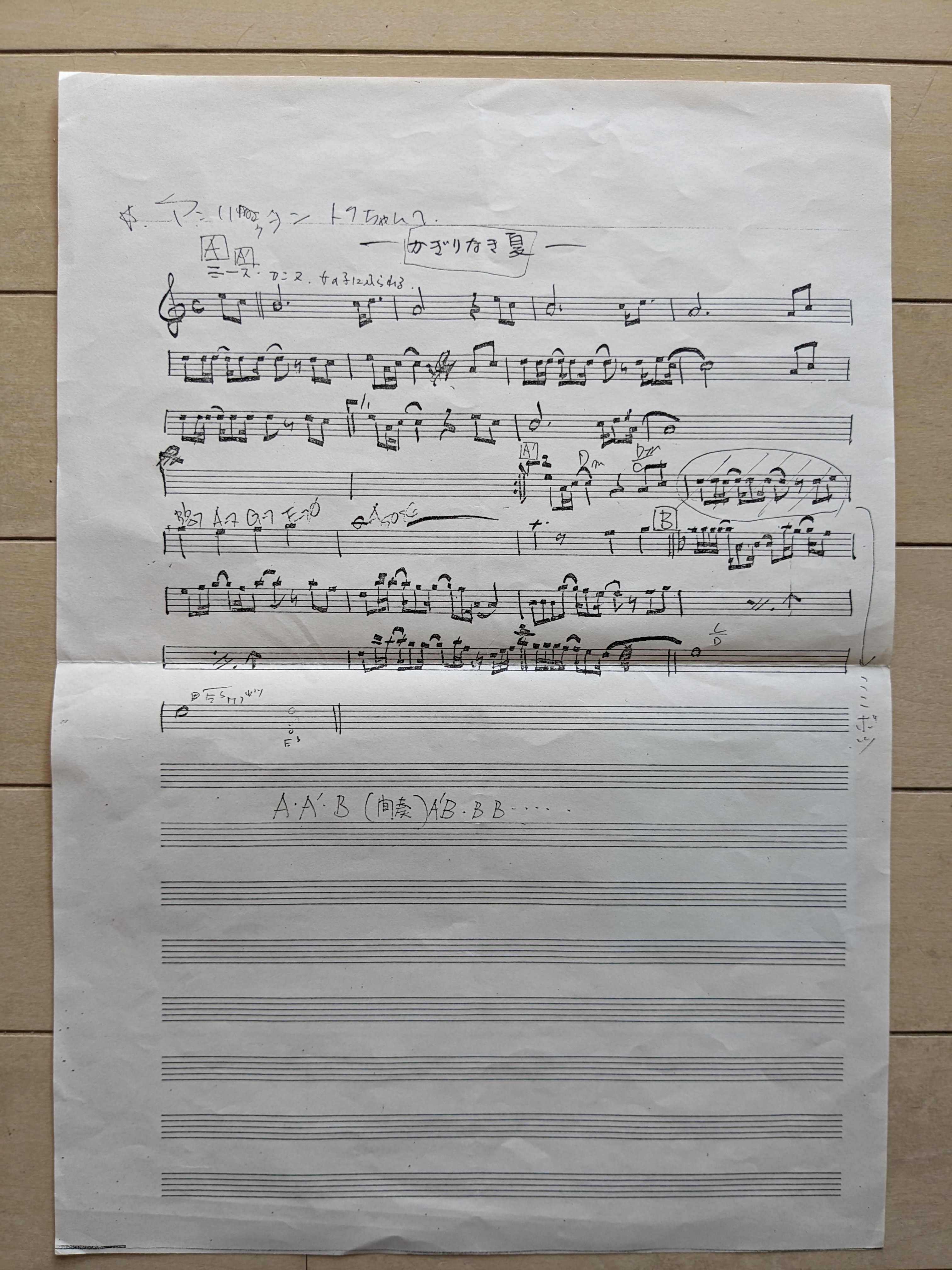
There were also notes reading “Nice, Cannes, rejected by girl.” This was undoubtedly sheet music for “Kagirinaki Natsu” written by Takizawa, who often composed while imagining foreign scenery and worldviews before lyrics.
I contacted Takizawa’s bereaved family to confirm whether this was Takizawa’s handwriting. Their email reply came a few days later:
“This is definitely sheet music written by Takizawa.”
The sheet music for “Kagirinaki Natsu” unexpectedly discovered at lyricist Sonomi Ari’s home not only showed the song was melody-first but also revealed what imagery Takizawa envisioned while composing.
The circumstances of Takizawa’s second album ‘BOY’ being shelved and the song being provided to Hideki Saijo, testimony from the director and lyricist of that time, the encounter between global city pop boom creator DJ Van Paugam and “Kagirinaki Natsu,” and now this sheet music discovery…
What do these “multiple miracles” surrounding this song mean?
The answer was hidden in the song itself.
The “Urban Magic” Cast on Hideki Saijo’s “Kagirinaki Natsu”
In January 2024, while researching Saijo’s version of “Kagirinaki Natsu,” I suddenly realized:
“Could this impressive drum and bass be performed by Jun Aoyama and Koki Ito?”
The CD and record of the album ‘GENTLE A MAN’ containing this song had no musician credits.
As a long shot, I asked Shinkawa, who handled the arrangement, but he replied “I don’t remember at all.”
However, according to someone who worked with Shinkawa in the 80s, Shinkawa often chose participating musicians at his discretion.
For a Takizawa composition with Shinkawa arrangement, choosing former Magical City members for drums and bass wouldn’t be surprising.
I sent a message to Ito’s office with the audio file attached: “Is this Hideki Saijo ‘Kagirinaki Natsu’ performed by the Aoyama-Ito ‘golden rhythm section’?”
A reply came hours later:
“This track is definitely the Jun Aoyama and Koki Ito combination.”
From their first performance together at Shiga Highland Hotel in 1976 until Aoyama’s death in 2013 – about 37 years – Ito had listened to Jun Aoyama’s drumming. He wouldn’t mistake Aoyama’s drums, which he described as “small metal sounds, big skin sounds.”
Yoichi Takizawa: composition, Hiroshi Shinkawa: arrangement/keyboards, Jun Aoyama: drums, Koki Ito: bass. A de facto “Magical City reunion” had been realized.
Hideki Saijo’s “Kagirinaki Natsu” was a song where the talents of those who laid the foundation for the global city pop boom crystallized.
That such a song was rediscovered by a DJ who pioneered Japan’s city pop boom across the ocean in the United States was perhaps inevitable.
Furthermore, this song had been preserved on VHS for 40 years by Hideki Saijo fan X user “Ether@Radio This Year Too (@45BYzE1QQJvGdzB),” showing Saijo performing it.
This song – never a single, only on albums, certainly not a hit – was performed by Saijo on television.
Hideki Saijo’s album ‘GENTLE A MAN,’ released March 5, 1984, marked its 40th anniversary in March 5 2024.
In this commemorative year, “Yoichi Takizawa and Magical City” was proven to have become truly “World Magical” through Hideki Saijo’s “Kagirinaki Natsu” and Van.
However, we mustn’t forget that this song reached the world only because of the 1982 tragedy of Yoichi Takizawa’s phantom second album ‘BOY’ being shelved. An “original version” sung by Takizawa exists.
Music writer Toshikazu Kanazawa, who “discovered” Takizawa’s ‘Leonids’ as a city pop masterpiece, spoke at the October 7, 2023 talk event ‘Mr. City Pop: The World of Yoichi Takizawa’ (at Espace Biblio, Ochanomizu) commemorating ‘Leonids’ 45th anniversary about Takizawa’s still-unreleased album ‘BOY’:
“This isn’t limited to Takizawa, but songs reaching the world or becoming big hits isn’t just about song quality or performance excellence. Luck, timing, and various conditions must align to take shape as records.
As today’s city pop boom shows, songs that sold poorly then – like Tomoko Aran being sampled by world-class artists or Miki Matsubara’s ‘Mayonaka no Door’ reaching only 28th on Oricon but becoming a worldwide hit – the ‘reevaluation axis’ between past and present is completely different.
No matter how old, properly made things get recognized. When I interviewed EPO, we discussed how ‘there are definitely things unchanged from the 70s-80s to now – universal things.’ This applies to Takizawa’s works too. No matter how much time passes, good things are good. It’s just the difference of ‘whether they reach the world’ or ‘whether they sell.’ Whether they take shape is like a ‘puzzle.'”
Understanding today’s global city pop boom is impossible using only the evaluation axis of contemporary hit status. Japanese city pop unknown even to Japanese people will continue being discovered worldwide by the evaluation axis of whether it can withstand “time’s test” when heard now or in ten years.
Van says:
“City pop is just beginning to explode in popularity worldwide. City pop remixes died as a trend in the 2010s. There should be more to spread – its history, influence on the West, etc.”
As he says, city pop may have just now been released from enthusiasts’ collections, spreading via internet, becoming standardized, and finally reaching ordinary people’s ears.
And Van’s beloved “Kagirinaki Natsu” is now attempting to “return triumphantly” to homeland Japan after a 40-year detour to distant Chicago.
When Yoichi Takizawa’s second album ‘BOY’ eventually reaches the world, this song will reach a major milestone.
According to Yoshikazu Ozawa of Warner Music Japan’s Warner Hybrid Strategic Japanese Music Division, Warner still has ‘BOY’s multitrack master tapes.
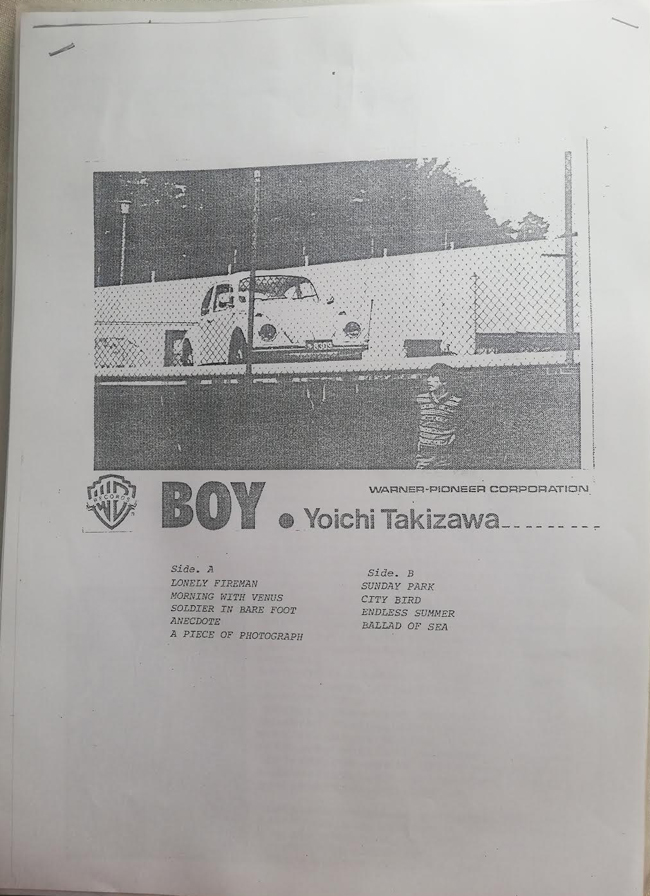
‘BOY’ PR 1982
However, the two mixed-down master tapes remain missing. Using the mix sound sources held by bereaved family members as reference, remixing from existing multitrack master tapes is possible.
With four multitrack masters, completely remixing these would require only mixdown and mastering costs (no recording costs), making CD master sound sources at reasonable expense.
On December 18, 2024, after much struggle, ‘BOY’ was finally released on CD and vinyl. Takizawa’s version of “Kagirinaki Natsu” was finally released after 42 years.
A week later, on December 25, 2024, a double A-side single record was released featuring Van’s remix of “Kagirinaki Natsu” and the miraculously discovered original 1982 mix. “Kagirinaki Natsu” became Takizawa’s new representative masterpiece.
https://mag2.base.shop/items/94322546

滝沢洋一『かぎりなき夏』Yoichi Takizawa ‘Kagirinaki Natsu’ EP illustration by: Eizin Suzuki
Hideki Saijo, Yoichi Takizawa, Magical City, and Van Paugam. Their “Endless Summer” had begun.
![The Miracle of City Pop “Endless Summer,” the Masterpiece Neither Tatsuro Yamashita nor Hideki Saijo Noticed: Yoichi Takizawa and Magical City – [Vol.3] Final Chapter](https://www.mag2.com/p/news/wp-content/uploads/2024/03/yoichi-Takizawa-Magical-City014-650x401.jpg "The Miracle of City Pop “Endless Summer,” the Masterpiece Neither Tatsuro Yamashita nor Hideki Saijo Noticed: Yoichi Takizawa and Magical City – [Vol.3] Final Chapter")