









いま読まれてます
The Fateful Encounter Between Shinkawa and Aoyama
Essential to Magical City’s history is the meeting between keyboardist Hiroshi Shinkawa and drummer Jun Aoyama. What led to their appearance before Takizawa?
Shinkawa recalls first meeting Aoyama:
“My high school girlfriend introduced him, saying ‘There’s a kid who’s good at drums at my school.’ Around 1973, I lived in Seta, Setagaya ward, and Aoyama said he lived in Kamino-ge, so I went to meet him. Normally, high school students aren’t home on Sundays, right? But Aoyama was home on Sunday, polishing his drums (laughs). He was a pale boy.”
Shinkawa then invited high school student Aoyama as a roadie for the disco band “Far East,” where Shinkawa played keyboards for Keio University’s “Black Culture Research Society.”
Aoyama, already attending Yamaha drum school in high school, had formed a Genesis cover band called “KANN,” but didn’t perform drumming with Far East. Aoyama would finally play drums on original songs when later invited by Shinkawa to Takizawa’s backing band.
Meeting Makino and Forming the Backing Band
In 1975, Takizawa was introduced to band members by Shunichi Arimoto, a Keio University student and dormitory junior at the “Student Education Dormitory” (Ichigaya, Tokyo) where Takizawa lived – housing for diplomat families’ children. The band was the aforementioned Keio disco band “Far East.” Arimoto played trumpet in Far East.
“This is dormitory senior Yoichi Takizawa, who has a contract with RCA Records.”
Arimoto introduced Takizawa to Far East keyboardist Hiroshi Shinkawa (Nihon University College of Art student), just-graduated high school student Jun Aoyama (working as Far East’s roadie), and Shinkawa’s childhood friend Yoshihito “Munta” Murakami (Meiji University student with a used Fender Jazz Bass).
Later, Shinkawa brought former “Bad Scene” guitarist Motoaki Makino (Char’s former band). Takizawa’s first backing band began with these four members.
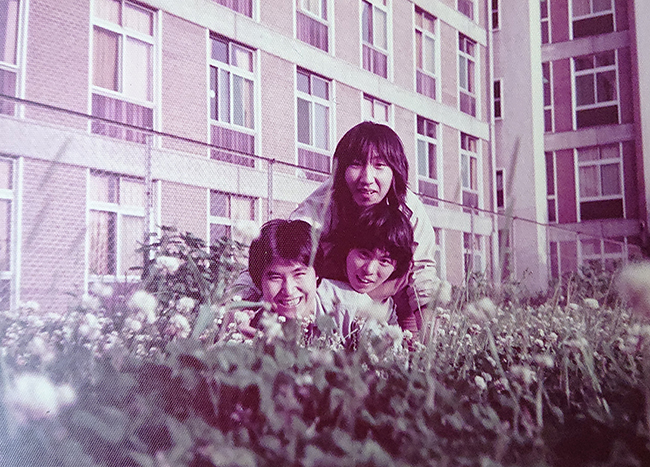
Motoaki Makino, Yoichi Takizawa, Jun Aoyama in Ichigaya, Tokyo 1975
Makino recalls that time:
“I think Shinkawa and I met around 1971. I was in a band called ‘Bad Scene,’ and Shinkawa played bass in a trio called ‘Three-Man Band.’ In an era before today’s live houses, students often pooled money to hold concerts, and we met through such events. Since Shinkawa played bass, I didn’t know he could play keyboards. We both played rock music then.”
Four years after meeting Shinkawa, in 1975, Makino received a phone call from Shinkawa:
“Would you like to join the backing band for singer Yoichi Takizawa, who’s scheduled to debut with RCA Records?”
Shinkawa had been Char’s elementary school classmate and formed the three-piece band “FOX” with Char and classmate Miura from ages 11-13. This gave Makino and Shinkawa the common connection of “having been in bands with Char.”
Introduced to Shinkawa, Aoyama, Murakami, and Makino, Takizawa invited them to be his backing band for original songs. The band wasn’t yet named “Magical City.” Shinkawa led the backing band formation.
The four frequently visited the Ichigaya education dormitory where Takizawa and Arimoto lived, repeatedly practicing within the dormitory. Based on tapes found at Takizawa’s home, they likely began band practice around summer 1975.
One discovered track, tentatively titled “Tomato Tomato Tomato,” is a samba-style song repeatedly chanting “Tomato.” Though the official title is unknown and sound quality is poor due to tape deterioration, the witty lyrical metaphors are interesting, showing their daily meetings with Takizawa for band practice.
Four Demo Songs Recorded at the Famous “Onkyō House” Studio
Through Robby Wada’s arrangement from their folk organization connection, Takizawa signed a publishing contract with RCA Records in 1974. From around 1975, he continued composing original songs with his backing band, seeking solo debut opportunities.
The opportunity came immediately after New Year’s. On January 22, 1976, RCA director Tasuku Okamura (known for handling Hideki Saijo and Toshiki Kadomatsu) organized demo tape recording for Takizawa and the four members at “Onkyō House” studio in Ginza, Tokyo. The purpose was Takizawa’s RCA solo debut.
Okamura reflects on that time:
“Takizawa aimed for music like Kirinji around 1975. But perhaps too early, it didn’t match the popular music in Japan then.”
1975 was the heyday of folk-style kayōkyoku and enka. The year Sugar Babe (Tatsuro Yamashita and Taeko Onuki) launched from Eiichi Ohtaki’s “Niagara” label, Western music-oriented Japanese pop wasn’t yet mainstream.
This Onkyō House demo recorded only four songs. However, it included the original “Minami no Hoshi e Yoru no Tabi” (later the title track of Takizawa’s only album ‘LEONIDSS NO KANATA NI’) and “Yasashii Koori,” which Takizawa once sang with folk guitar, performed by Takizawa, the four members, and Seikei University student Kabe on flute and saxophone.
Here are the four songs from Ryōjin “Munta” Murakami’s first and last studio recording as Takizawa’s backing band bassist: “Minami no Hoshi e Yoru no Tabi,” followed by “Mou Nakanaide,” “Omoide no Denwa-dori,” and “Yasashii Koori (RCA Take).”
This recording showcased 18-year-old Aoyama’s exceptional drumming throughout all songs, while Shinkawa’s beautiful piano already glimpsed arranger talent. 19-year-old Makino played sensual guitar solos in “Mou Nakanaide,” Murakami provided warm bass, and Takizawa’s faintly audible acoustic guitar gently enveloped listeners.
Seikei University student Kabe, called through Shinkawa, delivered excellent flute and alto saxophone performances. Despite being demos, these songs achieved high-quality arrangements rivaling actual recordings.
However, after this recording, the backing band’s bassist changed. Murakami’s replacement was Koki Ito, who would later work long-term with Jun Aoyama in Tatsuro Yamashita’s band.
![The Miracle Trajectory of City Pop: Takizawa Yoichi and Magical City – [Vol.2] Demo Tapes Filled with Masterpieces](https://www.mag2.com/p/news/wp-content/uploads/2023/07/20210417_135724-1-650x401.jpg "The Miracle Trajectory of City Pop: Takizawa Yoichi and Magical City – [Vol.2] Demo Tapes Filled with Masterpieces")