







いま読まれてます
The music genre of city pop has caused a worldwide boom over the past few years and has now established itself as a standard. While the music industry considers the band “Sugar Babe,” featuring Tatsuro Yamashita and Taeko Onuki, as the “pioneers of city pop,” do you know about the phantom band ” Yoichi Takizawa and Magical City” that was active almost simultaneously with Sugar Babe but whose existence was unknown until recently? Through interviews with related parties spanning nearly three years, it has become clear that they were the important band that laid the foundation for today’s global city pop boom. This series presents the “trajectory of city pop” by these five members, which has never been told in the history of Japanese pop music, along with a large amount of discovered unreleased sound sources over multiple installments.
[Additional Note] On January 8, 2025, Hiroshi Shinkawa, former member of Magical City, passed away suddenly at the age of 69. We express our deepest condolences here. This article maintains the original notation from the time of publication.
Original source (2023/09/15):
https://www.mag2.com/p/news/580492
Series Archive
- Vol.1 Miraculously Discovered Mass of Demo Tapes
- Vol.2 Masterpieces Recorded on Demo Tapes (This Article)
- Vol.3 The “Truth” That Neither Tatsuro nor Hideki Noticed
The Birth and Remarkable Fate of Yoichi Takizawa, Godfather of Magical City
(Continued from Vol.1) Singer-songwriter and composer Yoichi Takizawa (who passed away in 2006 at age 56), whose only work ‘LEONIDS NO KANATA NI (Beyond Leonids)’ (1978/Toshiba EMI) was first released on CD in 2015 and is now highly praised as a “city pop masterpiece” and “miraculous album.”
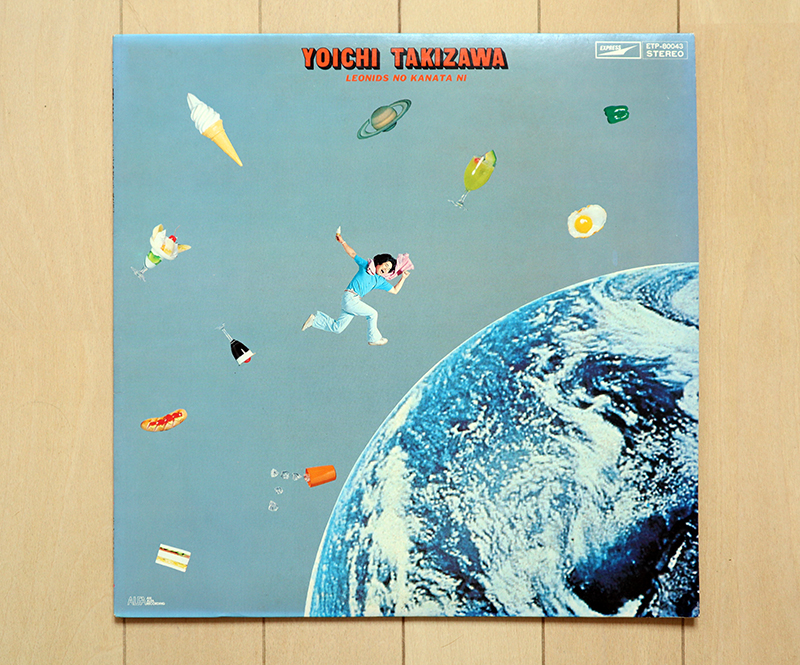
Yoichi Takizawa ‘LEONIDS NO KANATA NI(Beyond Leonids)’ (1978/Toshiba EMI)
The four musicians who started their careers as members of Takizawa’s backing band “Magical City” were so impressive that it’s surprising they haven’t been discussed in Japanese pop music history:
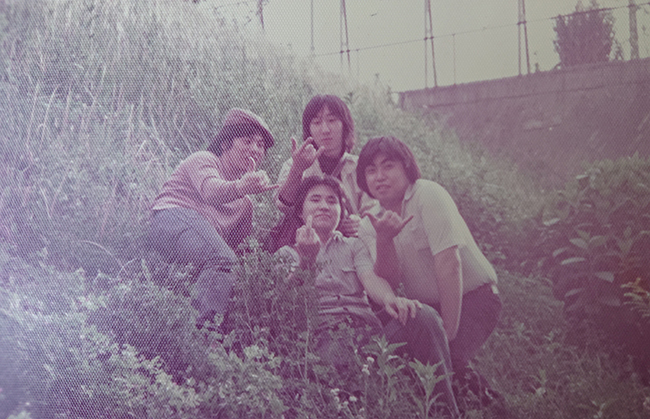
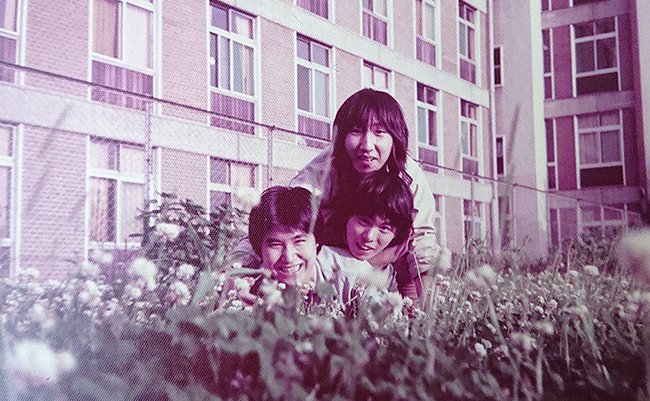
Around 1975 with Magical City members at Ichigaya Education Dormitory. The man in the hat on the left is Takizawa. Middle top is Makino, bottom is Aoyama, and Shinkawa. Photographed before Ito’s joining (Provided by Takizawa family)
Magical City
- Drums: Jun Aoyama
- Bass: Koki Ito
- Keyboard: Hiroshi Shinkawa
- Guitar: Motoaki Makino
Their “key person” was Yoichi Takizawa, who named the band and wrote the original songs they performed. Tracing his musical activities and background reveals numerous “miraculous encounters” that led to this global “city pop” boom.
Early Life and Influences
Yoichi Takizawa was born on March 9, 1950, in Tokyo as the eldest son of a Ministry of Foreign Affairs diplomat. Soon after birth, he spent his first three years in Portland, Oregon, where his father was stationed.
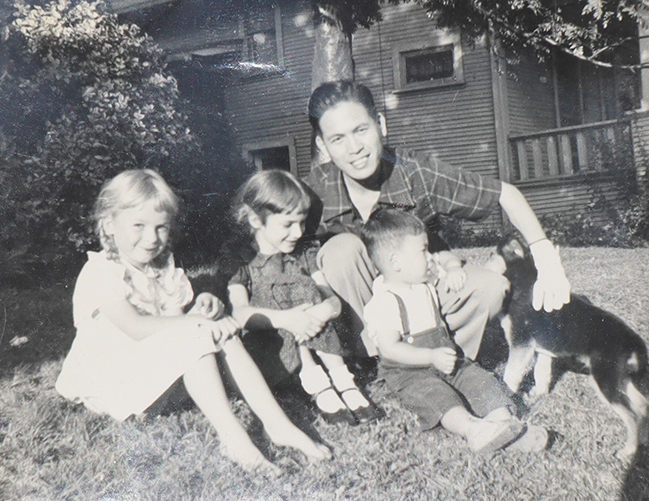
Yoichi Takizawa & his father in Portland, Oregon, USA 1952
After returning to Japan, he lived there until second grade, then moved to Tehran, Iran’s capital. He finally settled permanently in Japan at age 11 in fifth grade. His extended overseas childhood left him with a lasting inferiority complex about reading and writing Japanese, particularly kanji.
His familiarity with Western music during overseas life significantly influenced his musical sensibility. In fact, Takizawa noted in his profile for the single ‘Miami Dreaming’ (1980/RCA):
“Characterized by Western music-influenced songwriting gained through overseas experiences with his pop music-loving father, and refreshing vocals.”
Beatles, Folk Guitar, and Meeting “Robby Wada”
As a middle school student, Takizawa began copying The Beatles with a 3,000-yen guitar received as a Christmas present. After entering Tamagawa Gakuen High School, he joined the folk organization “MRA” (Moral Re-Armament movement) with friends, which had produced Mike Maki.
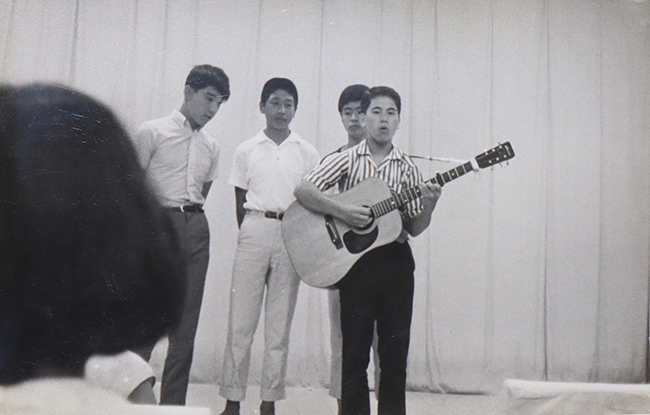
Yoichi Takizawa in Hight School 1966-1968
There he met folk singer Robby Wada (Ryochi Wada), who had inherited Maki’s position and would later become Japan’s first freelance music producer, creating major hits for Akiko Wada, Hideki Saijo, and Shigeru Matsuzaki.
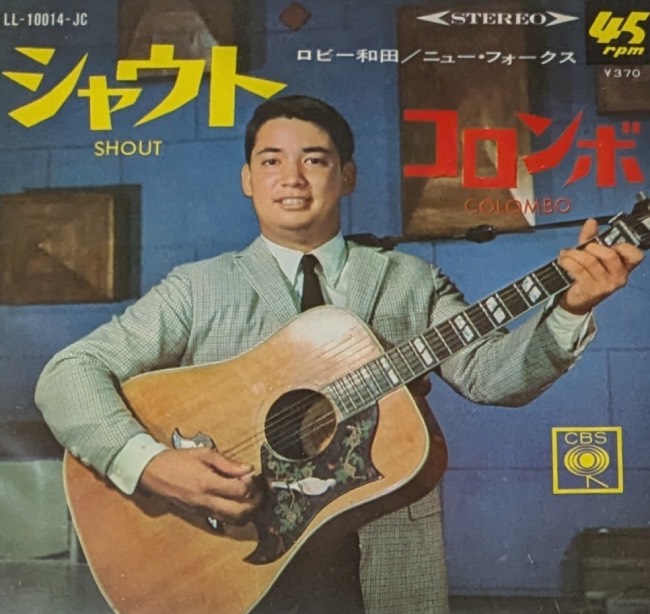
Robby Wada ‘SHOUT’ CBS 1966
Wada was known for founding the legendary 500+ member group “Let’s Go 66” in 1966, combining MRA folk groups for a legendary Budokan concert. High school student Takizawa was recognized for his talent by Wada. This meeting with Wada would later dramatically change Takizawa and his associates’ destinies.
Sound sources thought to be recorded by young Takizawa were discovered on open reel tapes. The home-recorded guitar ballad “Yasashii Koori” (Gentle Ice) showcases the beautiful voice of teenage Takizawa.
“Boku ga Aishita Sono Hito wo” (The One I Loved), with clear Group Sounds influence and full band performance, still sounds fresh today.
Alongside MRA activities, Takizawa formed TLMS (Tamagawa Light Music Society) gathering music lovers from Tamagawa Gakuen. Through TLMS activities, Takizawa created unique music that was “neither folk, rock, nor jazz.” Some songs composed around this time remained on open reel tapes found at Takizawa’s home.
“Station Elegy” is another example – recording date unknown but likely from late 1960s to early 1970s. The psychedelic melody with jazz-style arrangement creates a heavy, era-appropriate sound that’s pleasing to hear.
Ski Obsession and Return to Music Through Hospitalization
However, when Takizawa entered Tamagawa University, he became obsessed with skiing, obtained a first-class license, and began working as a ski instructor at mountain lodges. His skiing passion drew him away from music.
An unexpected turning point arrived when his chronic hepatitis B worsened, forcing long-term hospitalization and abandoning his dream of living as a professional skier.
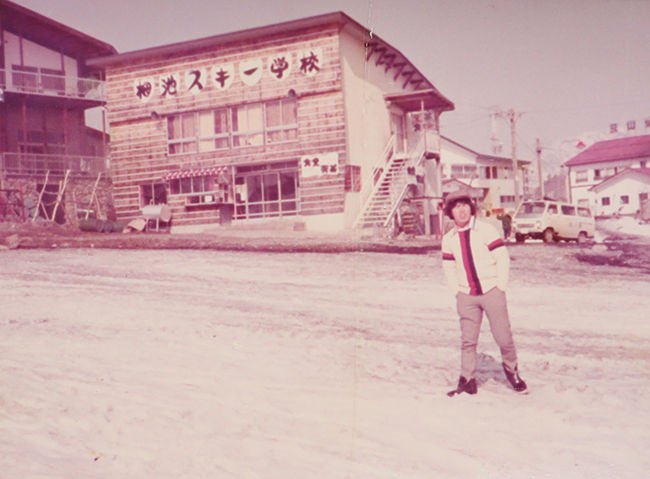
Yoichi Takizawa in Ski School 1969-1972?
During hospitalization, Takizawa listened to music on his bedside radio, became captivated by beautiful Western melodies, and returned to music. He began composing on his hospital bed and recorded demos after discharge.
After discharge, following his father’s advice, Takizawa attended computer programming school while working part-time, continuing composition and demo creation. He then visited Robby Wada, whom he’d known from MRA, bringing demos of accumulated songs.
At that time, Wada was a contract director for “RCA Records,” a Victor Music Industries division, successively producing hits like Akiko Wada’s “Waratte Yurushite” (1970), Hedva and David’s “Naomi no Yume” (1971), and Hideki Saijo’s “Kizudarake no Laura” (1974).
Wada had also written and composed the famous CM song “Mandam ~Otoko no Sekai” (1970) under another name. Rather than performing himself, Wada worked behind the scenes as a “creator.”
When Wada heard Takizawa’s home-recorded “Hitoribocchi no Kimi” (Lonely You), he loved it and used it as the B-side for idol group “Chako and Health Angels'” single “Nageki no Yubiwa” (1974). This became Takizawa’s “composer debut” and led to a publishing contract with RCA.
The sound source of Takizawa’s self-sung “Hitoribocchi no Kimi” was found on the same open reel tape. This debut song was both written and composed by Takizawa.
During his third hospitalization for liver disease, Takizawa fell in love with a high school girl eight years his junior who was hospitalized at the same hospital. She was the woman who would later become his wife. They met in the autumn of 1974. Around this time, with “Hitoribocchi no Kimi’s” single release already decided, Takizawa often played Beatles and Gilbert O’Sullivan songs for her on a bench in the hospital garden.
Sound sources from that period remained on cassette tape, including the beautiful, quiet masterpiece “Kootta Tokei” (Frozen Clock), written from a woman’s perspective. Takizawa’s crystal-clear voice retains its appeal nearly 50 years later.