








いま読まれてます
The music genre of city pop has caused a worldwide boom over the past few years and has now established itself as a standard. In the music industry, it has become accepted wisdom that the band “Sugar Babe,” featuring Tatsuro Yamashita and Taeko Onuki, was the “pioneer of city pop.” However, there existed a phantom band that was active almost simultaneously with Sugar Babe but whose existence was unknown until recently. Their name was “Yoichi Takizawa and Magical City.” Through interviews with related parties spanning over three years, it has become clear that they were the most important band that laid the foundation for today’s global city pop boom.
This series has featured the “trajectory of city pop” by these five members, which had never been told in the history of Japanese pop music, along with a large amount of discovered unreleased sound sources over multiple installments. This third installment marks the final chapter. We have traced the “miraculous trajectory” that their “path” brought to the world after more than 40 years.
[Additional Note] On January 8, 2025, Hiroshi Shinkawa, former member of Magical City, passed away suddenly at the age of 69. We express our deepest condolences here. This article maintains the original notation from the time of publication.
Original source (2024/03/5):
https://www.mag2.com/p/news/589273
Series Archive
- Vol.1 Miraculously Discovered Mass of Demo Tapes
- Vol.2 Masterpieces Recorded on Demo Tapes
- Vol.3 The “Truth” That Neither Tatsuro nor Hideki Noticed (This Article)
The “Unknown Masterpiece” Recorded Only on Albums
In January 2024, after Tatsuro Yamashita’s live tour ended, a message was sent to the office of bassist Koki Ito, who was busy with activities for his own band “Koki Tetragon.”
We have additional questions for Mr. Koki Ito. Would it be possible for Mr. Koki Ito to confirm the sound source attached to this message? This song was not released as a single and was only included on an album released in 1984. It was composed by Yoichi Takizawa and arranged by Hiroshi Shinkawa. We are investigating whether the drums and bass on this track were performed by Jun Aoyama and Koki Ito. If it is indeed the “golden rhythm section” of Aoyama and Ito, with Yoichi Takizawa’s composition, Shinkawa’s arrangement, and the Aoyama-Ito rhythm section, this would confirm it as essentially a “Magical City reunion” track. Incidentally, this album contained no musician credits whatsoever.
Just a few hours later, a reply arrived. Opening it nervously, it read:
“I confirmed with Koki Ito. The drums and bass on this track are definitely the Jun Aoyama and Koki Ito combination.”
…I read the same reply over and over again.
Production Begins on City Pop’s “Miraculous Album” ‘LEONIDS NO KANATA NI (Beyond Leonids)’
Singer-songwriter and composer Yoichi Takizawa (who passed away in 2006 at age 56), whose only work ‘LEONIDS NO KANATA NI’ (1978/Toshiba EMI) was first released on CD in 2015 and is now highly praised as a “city pop masterpiece” and “miraculous album.”
The four musicians who started their careers as members of Takizawa’s backing band “Magical City” were so impressive that it’s surprising they haven’t been discussed in the history of Japanese pop music:
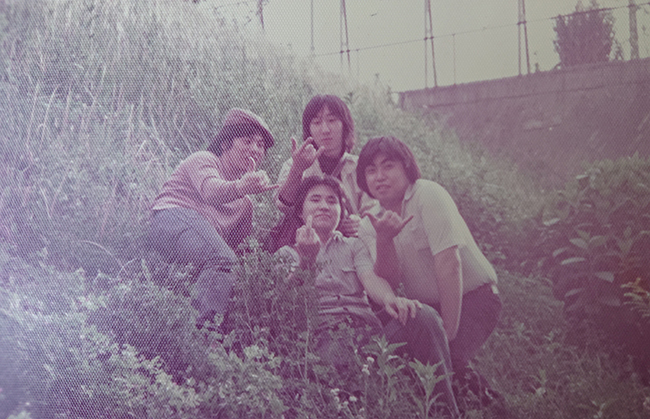
Around 1975 with Magical City members at Ichigaya Education Dormitory. The man in the hat on the left is Takizawa. Middle top is Makino, bottom is Aoyama, and Shinkawa. Photographed before Ito’s joining (Provided by Takizawa family)
Magical City
- Drums: Jun Aoyama
- Bass: Koki Ito
- Keyboard: Hiroshi Shinkawa
- Guitar: Motoaki Makino
At the end of 1976, Hiroshi Shinkawa left Magical City and moved to “Garbo-Jin,” the backing band for the vocal group “Hi-Fi Set” (derived from Akai Tori). The new keyboardist was Hidehiko Koike, an early member of Casiopea who later became a successful director at Victor, handling Beat Takeshi and Hiromi Iwasaki. From 1977, the Magical members began working as studio musicians.
In autumn of that year, production of Takizawa’s solo album ‘LEONIDS NO KANATA NI’ was decided. It would be co-produced by Toshikazu Awano, a second-year employee at Alfa Music, and Takizawa, marking Awano’s first album as director. “Leonids” refers to the Leonid meteor shower that appears around November each year.
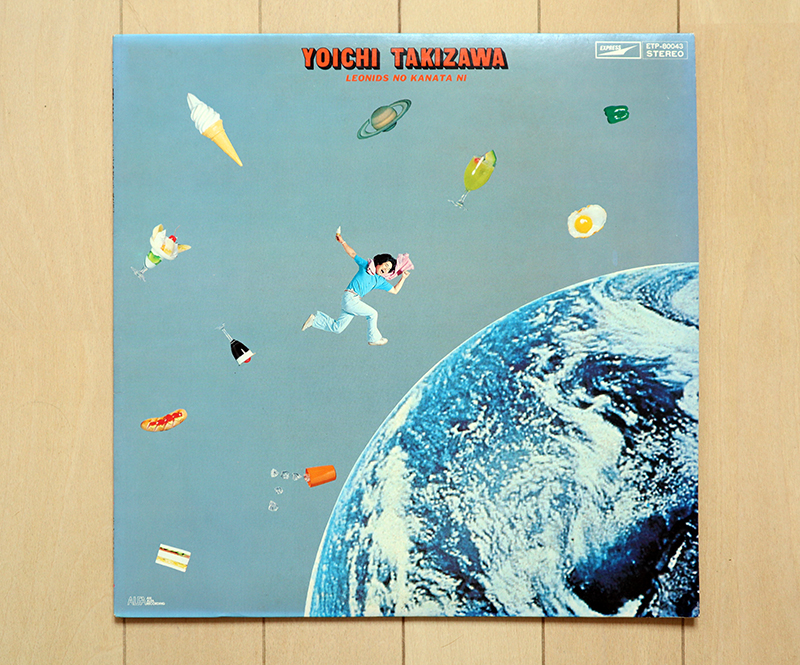
Yoichi Takizawa ‘LEONIDS NO KANATA NI(Beyond Leonids)’ (1978/Toshiba EMI)
At the time, Alfa had a “master tape supply contract” with Toshiba EMI, responsible for producing 4-5 albums annually. The contracting production company was “Alfa & Associates,” established in 1972. Takizawa’s ‘LEONIDS NO KANATA NI’ was selected as one of those five albums.
Awano recalls: “In 1977, there was no one else at Associates who could produce a full album. Takizawa had two types of demos – sound sources that Robby Wada brought from RCA, and recordings I made at Otowa Studio. We decided this would work and proceeded to develop it.”
The demo tapes by the former Magical members and Takizawa (see Vol.2 of this series) became the “deciding factor” for ‘Leonids’ production.
Hiroshi Sato Hired as Arranger: The “Golden Rhythm Section” Awakens with the Phantom Track “Hiyoke”
The arranger chosen for this album was the late Hiroshi Sato, a promising keyboardist who had participated in Tatsuro Yamashita’s album ‘SPACY’ (1977) and the studio musician group “Tin Pan Alley” led by Haruomi Hosono. Sato was known for declining YMO participation when approached by Hosono, citing his American aspirations. Sato’s hiring was reportedly at the direction of Alfa president Kunihiko Murai.
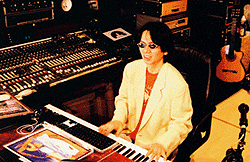
Hiroshi Sato(official HP)
Sato had previously worked with Takizawa on the album ‘BIRTH’ (1977/Victor) by the band “Broad Side” featuring Hisao Kurosawa, where he arranged Takizawa’s composition “Hoshi no Terrace.” A Takizawa self-cover version of this song was planned for inclusion in ‘Leonids.’
After Sato’s hiring was confirmed, several demos were recorded at Alfa’s “Studio A” and “Otowa Studio,” including the masterpiece “Saishū Bus” (Last Bus) that Awano fell in love with. Awano frequently visited Sato’s home near Daikanyama Station on the Toyoko Line for album planning discussions.
Among the tracks not included on the album was “Hiyoke” (Shade), a blues number featuring Aoyama and Makino that Ito particularly loved. This track showcased Sato’s exceptional arranging skills in both the intro and instrumental sections. The sound source was discovered on open reel tape at Takizawa’s home.
Ito recalls: “I remember well that there was a song called ‘Hiyoke’ that didn’t make it onto the album, and that was my favorite track. It was really cool – I think we just recorded a demo.”
That Ito remembered a single demo track recorded 45 years ago so clearly speaks to what an impressive masterpiece and performance it was. Regarding Takizawa’s talent as a songwriter, Ito commented, referencing “Hiyoke” and “Saishū Bus”:
“Despite all the various work I’ve done over the years, the fact that this remains so strongly in my memory shows what an amazing person he really was. He was a composer who could write songs that still sound good even in today’s era.”
Awano later regretted not including “Hiyoke” on Takizawa’s album:
“In my notes, I wrote ‘This might have been my mistake not to include this song – it’s such a beautiful piece.’ Even listening now, I think it’s a great song. I still feel sorry to Takizawa for not including ‘Hiyoke.'”
Jun Aoyama’s drumming, which had been criticized as “weak” by former member Shinkawa, had grown remarkably through a “rhythm training camp” with Ito at Shiga Kogen. The sound of that legendary “golden rhythm section” – the one-handed hi-hat work, kicks, and impressive slaps later showcased on Tatsuro Yamashita’s albums ‘RIDE ON TIME’ and ‘FOR YOU’ – was already perfected here.
Assembly of Luxurious Participating Musicians
‘LEONIDS NO KANATA NI’ featured many luxurious musicians beyond the Magical members Takizawa brought. Most were chosen by Sato. Awano, originally comfortable with guitar himself, was particularly committed to guitarist selection following advice from Alfa senior Junichi Goto to “go all out if you’re going to do it.” Sato also collaborated on this selection, with detailed discussions about which guitarist would play on which songs.
The impressive lineup included:
Electric Guitar: Shigeru Suzuki, Kiyoshi Sugimoto, Tsunehide Matsuki, Masaki Matsubara, Motoaki Makino, Yuji Toriyama
Acoustic Guitar: Chūei Yoshikawa
12-String Guitar: Kiyoshi Sugimoto
Drums: Jun Aoyama, Tatsuo Hayashi, Shuichi “Ponta” Murakami
Bass: Koki Ito, Kenji Takamizu
Classical Piano: Naoya Matsuoka
Keyboards & All Arrangements: Hiroshi Sato
Alto Saxophone: Jake H. Conception, Takeru Muraoka
Tenor Saxophone: Kiyoshi Saito
Trumpet: Koji Hatori, Susumu Kazuhara, Kenji Yoshida
Trombone: Eiji Arai, Sumio Okada
Percussion: Motoya Hamaguchi, Larry Sunaga, Pecker (Masato Hashida)
Strings: Tamano Ensemble
Recording with this unprecedented lineup continued until spring 1978, conducted at four studios: Alfa’s “Studio A,” “Onkyō House,” “Sound City,” and “Media Studio.” The album is now available on Spotify and other streaming services, including “Last Story” featuring 20-year-old Jun Aoyama performing with 23-year-old Koki Ito.
Toshikazu Kanazawa’s Foresight in Illuminating ‘Leonids’
The compilation was released in January 2015 under the name ‘Light Mellow Wave,’ primarily featuring songs owned by Alfa Records in a city pop compilation.

『Light Mellow Wave』(2015)
This album was planned by music writer Toshikazu Kanazawa, who brought attention to Takizawa’s ‘Leonids’ through his “Light Mellow” series of guidebooks and reissue CDs, realizing the first CD release of ‘Leonids.’
The inclusion of “Marina Highway” in this compilation led to the July 2015 CD release of ‘Leonids,’ sold exclusively online through Japan’s Tower Records and Sony Music Shop. Kanazawa reflects on the struggle to achieve CD release:
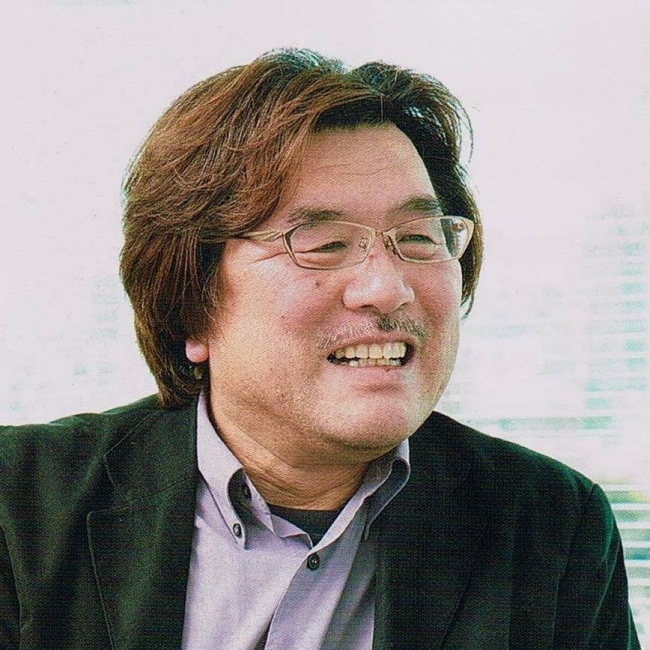
Toshikazu Kanazawa
“I first introduced ‘Leonids’ in my disc guide ‘Light Mellow Wamono 669’ (2004), billing it as ‘Unknown Masterpiece by Craftsmen No. 3.’ While numbers 1 and 2 were CD-released relatively quickly, ‘Leonids’ took over 10 years. Despite high industry praise, it was that unknown. I was thrilled when the CD release was finally decided.”
Thus, Takizawa’s only work ‘Leonids’ has become highly regarded among Japanese music fans as a “hidden masterpiece” and “miraculous album,” with original LP records now trading for tens of thousands of yen. However, the original record sold poorly upon release, and few industry insiders knew of its existence.
If Kanazawa hadn’t “discovered” this album, the history of Takizawa and Magical might still remain “unknown” today. The significance of Kanazawa, the original pioneer of the city pop boom, excavating this album – a major clue for understanding the dawn of Japanese city pop – is immeasurably large.
As Japanese “Modest Resistance”
Several years after Kanazawa realized the CD release, overseas music enthusiasts would “discover” their sound through their ears.
YouTube features videos of American men discussing the appeal of Takizawa’s ‘Leonids.’ Even albums unknown to most Japanese are being recognized by discerning overseas music fans.
Music writer Ryohei Matsunaga, who frequently writes about city pop, expressed concern about how overseas fans continue discovering Japanese music unknown even to Japanese people. He spoke about the importance of introducing hidden masterpieces like Takizawa’s ‘LEONIDS NO KANATA NI’ to the world as “modest resistance” by content creators on BSFuji’s “HIT SONG MAKERS ~Glorious J-POP Legend~” CITY POP Special.
Matsunaga: “Just recently on Twitter (now X), lists of ‘Japanese records that overseas people wanted in 2021’ appeared, and I was really surprised at how well they listened. From major releases to self-produced ones.
It’s like we can’t compete. If it’s a battle of 100 million versus 7 billion, we might already be entering a situation where we can’t keep up.
But within that… for example, Yoichi Takizawa, who was a composer at Alfa in the 1970s. ‘LEONIDS NO KANATA NI’ is a really good album. Alfa has finally started worldwide distribution so people can listen to it.
I want people to listen to things like that – it might be very important to continue small resistance as content creators, that kind of modest resistance.”
The Musical Network Connected by Yoichi Takizawa
Tracing the history of Takizawa and Magical revealed that Takizawa was beloved by many junior musicians and served as a connector of musical networks. Shinkawa reflects:
“At this age, as everyone begins archiving various things from that time, I realize anew that Takizawa lived through that era in the same way I did. And that Takizawa was the person who brought Kunihiko Murai, Yuming, and others into my orbit.”
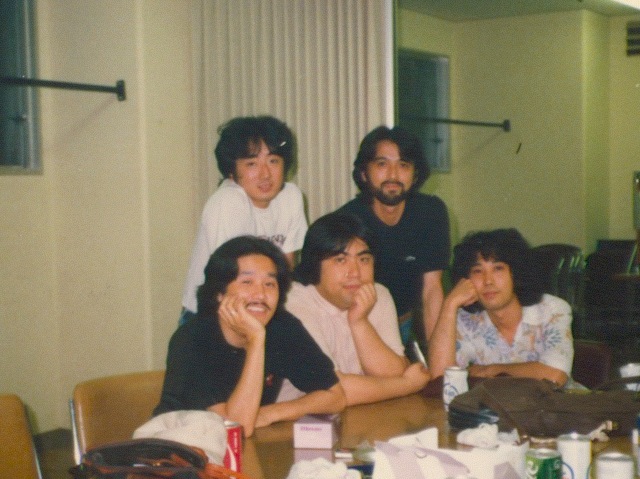
Hiroshi Shinkawa (Center) during his time as part of Yuming’s backing band
Takizawa continued creating outstanding songs with presence as a songwriter, and his works remained in his musical colleagues’ ears even after more than 40 years. The masterpiece album ‘Leonids,’ packed with the appeal of the Takizawa sound, was completed through the interweaving of time spent with Magical members and shared experiences of hardship and joy.
After completing his solo album with Magical City members, Takizawa expanded his field of activity as a “composer,” providing songs to many singers, talents, and idols including Beat Takeshi (Takeshi Kitano), Bread & Butter, Circus, Kaoru Sudo, Kyoko Koizumi, Iyo Matsumoto, Hiromi Iwasaki, Hideki Saijo, Hidemi Ishikawa, Kumiko Yamashita, Yasuko Tomita, Mitsuko Komuro, Yukari Ito, Yumi Seino, and Ayumi Ishida.
Meanwhile, Hiroshi Shinkawa entered the professional arranger’s path after handling all song arrangements for Hi-Fi Set’s album ‘Coming Up’ (1978) through his connection with “Garbo-Jin.”
He went on to arrange almost all songs for the highly acclaimed city pop masterpiece album ‘Thanks Giving’ (1988/Vap) by RA MU (featuring Momoko Kikuchi as lead vocalist), almost all songs by 1986 Omega Tribe including “Kimi wa 1000%,” Tomoyo Harada’s “Toki wo Kakeru Shōjo,” Minako Honda’s “1986-nen no Marilyn,” Asami Kobayashi’s “Amaoto wa Chopin no Shirabe,” Yoko Oginome’s “Roppongi Junjōha,” and Meiko Nakahara’s “Kimi-tachi Kiwi Papaya Mango da ne.”
The Four Members of New Magical and Hiroshi Sato
The four members of new Magical (Jun Aoyama, Koki Ito, Motoaki Makino, Hidehiko Koike) continued working with Hiroshi Sato, whom they met during ‘Leonids’ recording. Ito describes the progression:
“After finishing the ‘Leonids’ recording, in June 1978, we all went to Sato’s home with a Thirty-One ice cream cake to celebrate his 31st birthday. That’s when Sato said he wanted a long relationship with us, and Magical City was taken in entirely by Hiroshi Sato, adding guitarist Yuji Toriyama and percussionist Pecker (Masato Hashida) to form ‘Hiroshi Sato and High Times.'”
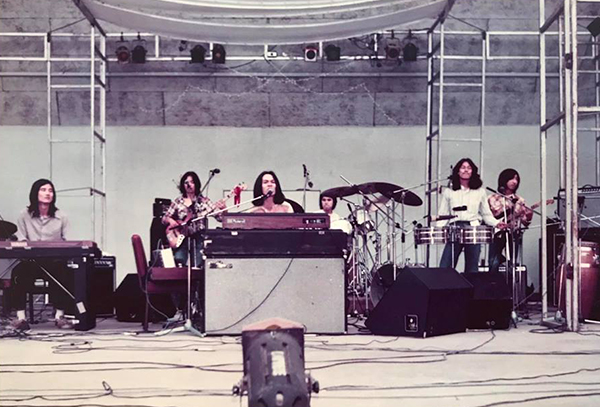
Hiroshi Sato and High Times in Hibiya Yaon 1978. image by: Koki Ito office
Magical was absorbed entirely by Sato, continuing in the transformed shape of “Hiroshi Sato and High Times.” While the Magical name disappeared and they were effectively disbanded, rather than decreasing, the members increased by two (Pecker and Yuji Toriyama), connecting new networks. High Times eventually dissolved naturally without releasing an album, but Sato’s solo album ‘Orient’ (1979/Kitty) features the names of Ito, Aoyama, Koike, Toriyama, and Pecker.
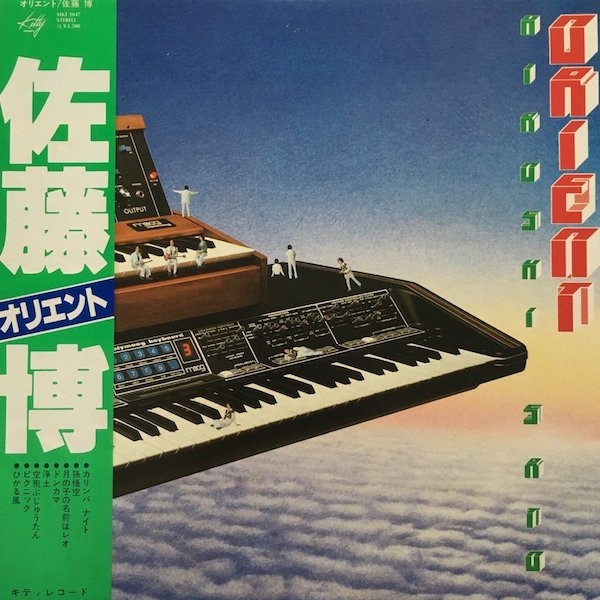
Hiroshi Sato ‘ORIENT’ 1979/Kitty image by: dicogs
Even when individual activities diverged, the invisible bonds of Magical certainly continued. And it didn’t take much time for these connections to bear fruit in the form of “city pop.”
From 1977 to 1979, after each leaving memorable performances on famous artists’ solo albums, Magical’s “rhythm section” of Ito and Aoyama would finally encounter their destiny. In summer 1979, Alfa-affiliated Minako Yoshida and ‘Leonids’ recording member Shuichi “Ponta” Murakami introduced Jun Aoyama and Koki Ito to a certain person.
That person was Tatsuro Yamashita.
The Miraculous Encounter of Tatsuro Yamashita and the Golden Rhythm Section